

What Spanish looks like at St Laurence
At St Laurence, our Spanish curriculum inspires children to develop an interest in languages and a curiosity about the wider world.
Spanish is taught throughout Key Stage 2 using Kapow Primary. Lessons develop the five key areas of language learning: listening, speaking, reading, writing and grammar. Children are given regular opportunities to hear, practise and use Spanish in a range of meaningful and enjoyable contexts.
Our aim is for pupils to become confident language learners who are willing to have a go, learn from mistakes and communicate with increasing independence. Learning Spanish also helps children to explore the relationship between language, identity and culture.
Our curriculum aims
Through our Spanish curriculum, children will:
• develop confidence in listening and responding to spoken Spanish
• speak clearly using familiar vocabulary, phrases and sentences
• read and understand increasingly complex words and texts
• write words, phrases and sentences for different purposes
• develop an understanding of Spanish grammar
• build a growing bank of vocabulary
• develop accurate pronunciation and intonation
• learn about Spanish-speaking countries and cultures
• develop curiosity, confidence and enjoyment in language learning
How we teach Spanish
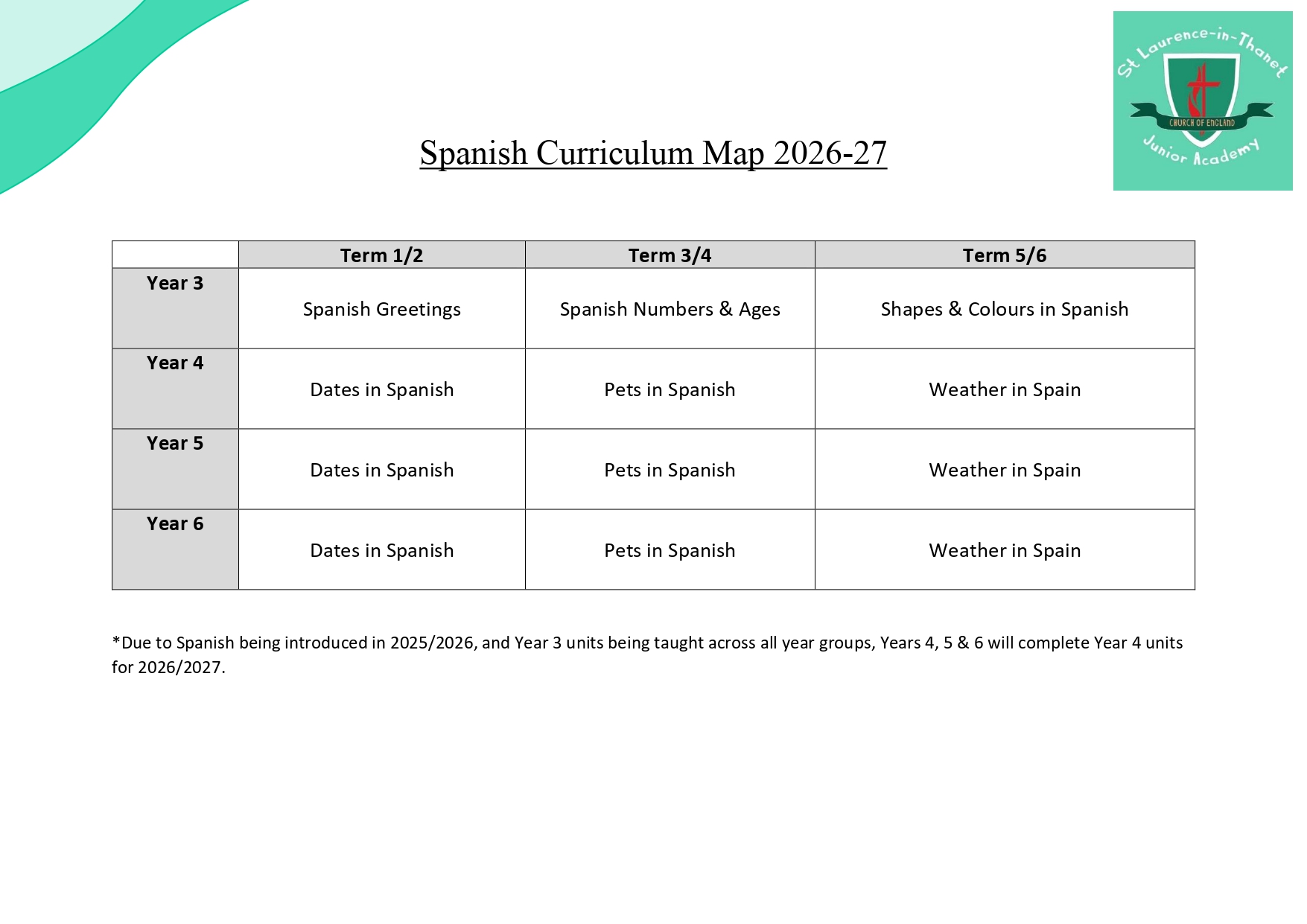
Spanish is taught weekly for three terms of each academic year using the Kapow Primary scheme of work and resources.
Lessons are interactive and include a wide range of engaging activities, including:
• songs and rhymes
• stories
• games
• conversations and role play
• listening activities
• reading and matching tasks
• short written activities
• opportunities to practise pronunciation
Teachers model new language clearly and give children frequent opportunities to repeat, rehearse and apply what they have learnt.
Learning is carefully sequenced. Each lesson builds upon previous teaching and children revisit vocabulary, grammatical structures and language patterns regularly. As they progress through the school, pupils use increasingly complex language with greater confidence and independence.
What children learn
Throughout Key Stage 2, children progressively develop their knowledge and skills across the main areas of language learning.
• Listening
• Speaking
• Reading
• Writing
• Grammar
• Intercultural understanding
By the end of Year 6
By the end of Key Stage 2, children will be able to:
• listen to and understand familiar spoken Spanish
• take part in short conversations
• ask and answer questions using familiar language
• speak with increasingly accurate pronunciation and intonation
• read and understand short texts
• write phrases and sentences for a range of purposes
• apply familiar grammatical structures
• use a dictionary or vocabulary resource with growing independence
• recognise patterns and connections between Spanish and English
• approach unfamiliar language with confidence and curiosity
• appreciate the value of learning another language
Enrichment and wider opportunities
Children are encouraged to use Spanish beyond individual lessons through songs, games, classroom routines and links with other areas of learning.
They also explore aspects of life and culture in Spanish-speaking countries, including traditions, celebrations, food, music and everyday life. These opportunities help pupils to understand that Spanish is a living language spoken by people in many parts of the world.
Pupil voice
.png)
Supporting all learners
Our Spanish curriculum is adapted so that every child can participate, make progress and experience success.
Teachers may use visual prompts, gestures, songs, repetition, vocabulary mats, sentence stems and opportunities for paired rehearsal. New language is introduced in manageable steps and revisited regularly.
Children are encouraged to participate without fear of making mistakes. Speaking together as a class, working with a partner and using familiar routines help pupils to build confidence before applying their learning independently.
Personal and spiritual development
Learning Spanish encourages children to appreciate different languages, identities and cultures.
Pupils consider how language connects people and helps us to understand the experiences and perspectives of others. They develop respect, curiosity and openness towards communities beyond their own.
Learning another language also requires courage and perseverance. Children learn that mistakes are a natural part of learning and that confidence grows through practice, resilience and a willingness to try again.
Spanish Intent, Implemetation and Impact Statement