


What English looks like at St Laurence
At St Laurence, English is at the heart of our curriculum. Through reading, writing, speaking and listening, children develop the knowledge, confidence and communication skills they need to succeed across every subject and throughout their lives.
Our English curriculum is made up of several closely connected areas:
• reading
• phonics
• writing
• grammar and punctuation
• spelling
• speaking and listening
Although these areas are taught explicitly, they are brought together throughout the curriculum. Children read as writers, use discussion to develop their ideas and apply their knowledge of vocabulary, grammar, punctuation and spelling when communicating for different purposes.
Our curriculum aims
Through our English curriculum, children will:
• become confident, fluent and enthusiastic readers
• develop a lifelong enjoyment of books and reading
• understand and discuss a wide range of texts
• write clearly, accurately and creatively for different purposes
• develop a rich and varied vocabulary
• speak confidently and listen respectfully
• use grammar, punctuation and spelling accurately
• organise and communicate their ideas effectively
• reflect on, edit and improve their work
• develop confidence, independence and resilience as communicators
What Reading looks like at St Laurence
Reading is the cornerstone of learning at St Laurence and provides the foundation for success across the wider curriculum. We aim for every child to leave primary school as a confident and capable reader who enjoys books and understands how reading can help them discover new ideas, experiences and perspectives.
Children encounter a broad range of high-quality fiction, non-fiction, poetry, speeches and plays. Our carefully planned reading spine introduces pupils to different authors, cultures, genres and increasingly complex texts as they move through Key Stage 2.
Teachers regularly read aloud to their classes, allowing every child to experience rich and engaging literature. Books are selected to reflect children’s interests, support curriculum learning and introduce pupils to a diverse range of contemporary and established authors.
How we teach Reading
Whole Class Reading
Whole Class Reading sessions are based on carefully selected books, extracts and other high-quality texts. Children are explicitly taught the knowledge and strategies needed to understand increasingly complex material. Lessons develop children’s ability to:
• retrieve information
• explain ideas
• make inferences
• justify responses using evidence
• predict what may happen
• summarise information
• explore vocabulary in context
• consider an author’s choice of language
• compare ideas, characters and texts
• discuss different interpretations
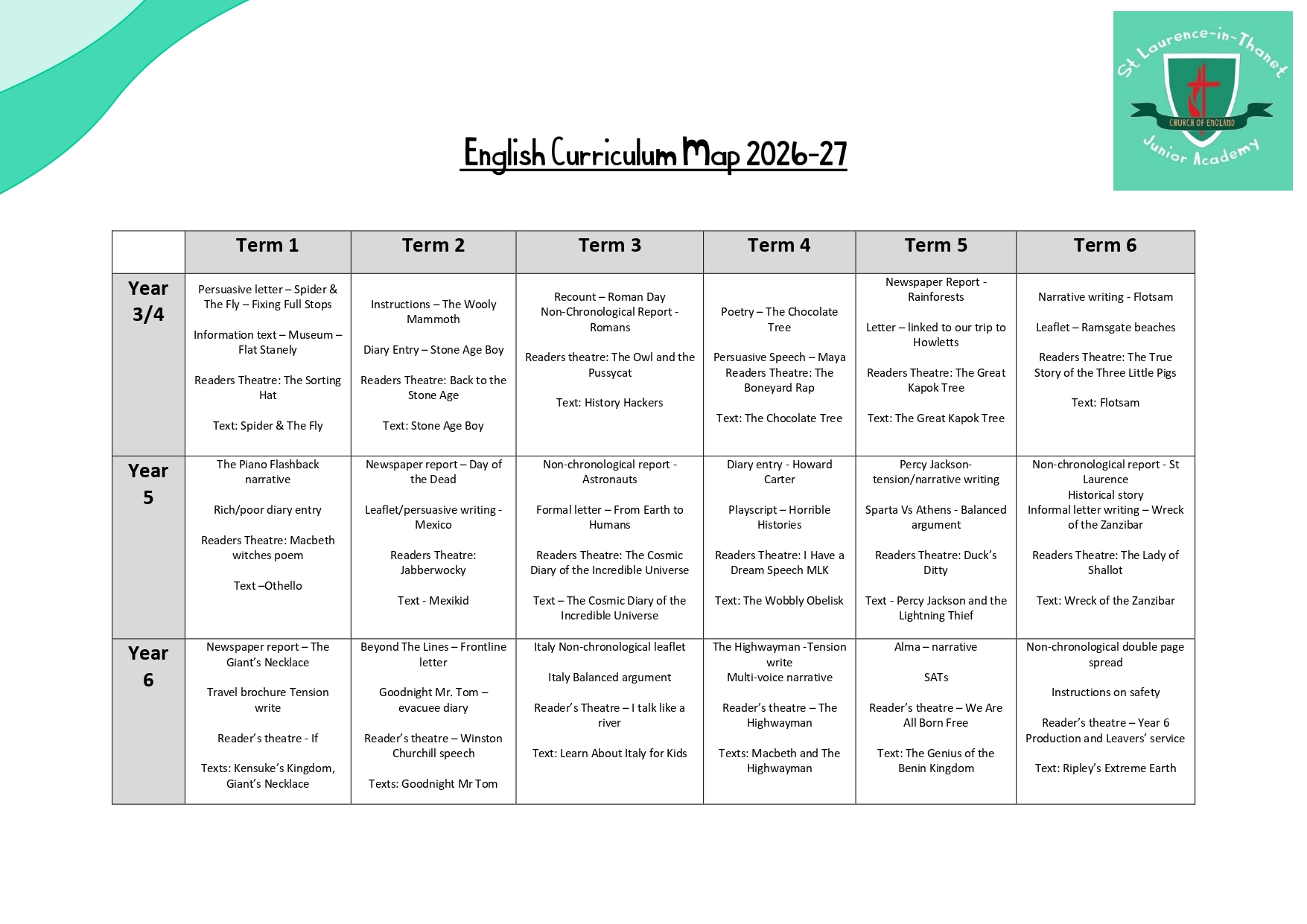
Children are encouraged to express their views, listen carefully to others and return to the text to support their responses. Our reading spine ensures that pupils experience a carefully sequenced range of texts throughout Years 3 to 6. Alongside the core reading texts, each term includes a planned Readers Theatre text, including poetry, speeches, narrative extracts and performance pieces.
Readers Theatre
Readers Theatre is an important part of our Reading and Oracy curriculum. Each term, children complete a two-week unit of lessons based on a carefully selected text.
During each unit, pupils explore the meaning, vocabulary and structure of the text before preparing it for performance. They learn how fluency, expression, pace, volume, intonation and gesture can help communicate meaning to an audience.Readers Theatre gives children opportunities to:
• read and reread a text closely
• develop accuracy, fluency and expression
• explore vocabulary and meaning
• discuss characters, themes and viewpoints
• rehearse lines collaboratively
• listen and respond to others
• speak clearly and confidently
• adapt their voice for purpose and audience
• perform to their peers
• reflect upon and improve a performance
The programme exposes children to a wide range of challenging material, including poetry, traditional texts, speeches, Shakespeare, diverse perspectives and texts containing figurative or symbolic language.
The selected texts also introduce pupils to features such as archaic language, complex narrators, non-linear sequences, symbolism, diverse perspectives and increasingly intricate plots. This helps children develop the confidence and knowledge needed to engage with more demanding texts.
Readers Theatre supports children who may be less confident readers by allowing them to rehearse and perform alongside others. It also provides appropriate challenge for fluent readers, who must consider interpretation, expression and how language should be communicated effectively.
Reading for pleasure
We want reading to be an enjoyable and valued part of everyday school life.
Children have regular opportunities to:
• choose books independently
• visit the school library
• listen to adults reading aloud
• recommend books to one another
• discuss authors and stories
• explore unfamiliar genres and subjects
• read at home and in school
• celebrate their reading achievements
Our school library contains a wide range of current and engaging books. We hold regular DEAR sessions, which stands for Drop Everything and Read.
During these sessions, the whole school pauses to enjoy reading for pleasure in a calm and relaxed environment. The school library is also open during DEAR time, allowing children to return completed books and choose something new to read. These sessions help to build positive reading habits, encourage independence and ensure that children have regular opportunities to explore books that interest them.
Accelerated Reader
We use Accelerated Reader to support children’s independent reading.
Children complete regular assessments which help staff identify an appropriate reading range. They then choose books from within a personalised range, allowing them to experience success while gradually developing greater fluency, stamina and understanding.
After completing a book, children can take a short online quiz to check their comprehension and celebrate their progress. Accelerated Reader helps teachers monitor reading habits and identify pupils who may require additional support or challenge.
What Phonics looks like at St Laurence
Phonics remains an important part of our reading provision for children who need additional support with decoding, fluency and spelling.
Every child’s phonics knowledge is assessed when they join St Laurence. Pupils who require further support follow Read Write Inc. Phonics or Fresh Start, which is designed specifically for older children who still need structured phonics teaching.
How we teach Phonics
Children receive regular teaching in small, carefully organised groups. Sessions help pupils to:
• recognise sounds and corresponding letters
• blend sounds to read words
• segment words for spelling
• read increasingly fluently
• understand what they have read
• develop confidence as readers and writers
Progress is assessed regularly so that teaching and intervention can be matched closely to each child’s needs. Teaching and support staff receive training and regular refresher sessions in the delivery of Read Write Inc.
What Writing looks like at St Laurence
Our Writing curriculum enables children to communicate their ideas clearly, accurately and creatively.
Writing units are inspired by high-quality books, picture books, short stories and meaningful links with subjects such as Science and History. Each unit begins with an engaging stimulus which captures children’s interest and gives them a clear purpose for writing. Children write for a wide range of purposes and audiences, including to:
• entertain
• inform
• explain
• persuade
• describe
• discuss
• recount
They learn that effective writing involves planning, drafting, revising, editing and presenting rather than completing a piece in one attempt.
How we teach Writing
Writing is taught through a carefully structured sequence which helps children move from exploring ideas to producing an independent final outcome.
Our writing progression begins with explicit teaching of ambitious vocabulary and genre features. Children then explore sentence structures, plan their work, complete a first draft, edit and improve it before producing a final published version.
Children are encouraged to reread and edit as they write. Once the first draft is complete, they review the whole piece, improve vocabulary and respond to feedback before creating a carefully presented final copy.
Children consider the effectiveness of their writing and make changes to improve meaning, vocabulary, sentence structure and organisation.
What Grammar and Punctuation look like at St Laurence
Grammar and punctuation help children understand how language works and how meaning can be communicated clearly and effectively.
As children progress through Key Stage 2, they make increasingly deliberate grammatical choices to suit different audiences, purposes and forms of writing. They also learn to discuss language using accurate grammatical terminology.
At St Laurence, children develop secure knowledge of sentence structure, word classes, verb forms, punctuation and standard English. They learn to recognise these features in the texts they read and to use them accurately and purposefully in their own speaking and writing.
How we teach Grammar and Punctuation
Grammar and punctuation are taught explicitly through regular, focused lessons using Spelling Shed resources. New concepts are introduced through clear explanations, modelling and worked examples before children practise and apply them independently.
Teaching is closely linked to reading and writing so that children understand how grammatical choices and punctuation affect meaning. Pupils explore examples from high-quality texts, discuss the effect of different sentence structures and then apply this learning within their own writing.
Lessons may include:
• identifying and discussing grammatical features
• practising new skills through short activities
• improving and combining sentences
• exploring how punctuation changes meaning
• using accurate grammatical terminology
• applying learning within a writing unit
• proofreading and correcting errors
• revisiting previous learning through regular retrieval practice
Grammar and punctuation are also embedded within each writing sequence. Children are taught the features most relevant to the genre they are studying, then expected to use them when planning, drafting, editing and improving their work.
What Spelling looks like at St Laurence
Spelling is taught systematically using Spelling Shed resources. Lessons develop children’s understanding of spelling patterns, phonics, morphology, word families and common exceptions.
Children are taught that spelling is not simply about memorising lists of words. They explore how words are constructed, recognise relationships between words and apply patterns and rules when encountering unfamiliar vocabulary.
How we teach Spelling
Spelling teaching includes:
• phonics and sound patterns
• spelling rules and patterns
• prefixes and suffixes
• root words and word families
• statutory words
• commonly confused words
• vocabulary and word meanings
• proofreading and correcting errors
• applying spelling knowledge within independent writing
New spelling patterns are introduced explicitly and practised through short, regular activities. Children are given opportunities to investigate words, identify similarities and explain the rules or patterns they notice.
Spelling Shed provides games, activities and resources which support learning in school and allow pupils to practise at home. Teachers use assessment and children’s independent writing to identify patterns which need to be revisited.
Pupils who require additional support with spelling may also receive targeted phonics teaching through Read Write Inc. Phonics or Fresh Start.
What Speaking and Listening look like at St Laurence
Speaking and listening, or oracy, are developed throughout the English curriculum and across all areas of school life.
Children are taught to communicate their ideas clearly, listen attentively and respond appropriately to others. They are given regular opportunities to explain, question, discuss, debate, perform and present.
Readers Theatre makes a particularly strong contribution to oracy. Through rehearsing and performing texts, children learn how to use their voices effectively, respond to an audience and work collaboratively to communicate meaning.These experiences help pupils to:
• develop confidence when speaking
• organise and express their thoughts
• listen carefully to different perspectives
• build and use a rich vocabulary
• give reasons for their opinions
• ask relevant questions
• adapt their speech for different audiences
• contribute respectfully to discussions
• rehearse ideas before writing
• perform with fluency and expression
By the end of Year 6
By the end of Key Stage 2, children will be able to:
• read fluently and with appropriate expression
• understand and discuss a broad range of texts
• retrieve, infer, predict, summarise and explain
• support their interpretations with evidence
• engage confidently with increasingly challenging texts
• read regularly for enjoyment and information
• write effectively for a range of audiences and purposes
• organise ideas into coherent sentences and paragraphs
• select vocabulary and grammatical structures thoughtfully
• use punctuation and spelling with increasing accuracy
• plan, draft, revise and edit their work
• speak confidently and listen respectfully
• perform texts with fluency, expression and understanding
• communicate ideas clearly in preparation for secondary school
Enrichment and wider opportunities
We promote a positive culture of reading, writing and communication throughout school life. Opportunities may include:
• World Book Day
• author visits and virtual events
• reading celebrations and challenges
• library activities
• poetry and performance
• Readers Theatre performances
• drama and storytelling
• writing competitions
• opportunities to write for genuine audiences
• class novels and shared reading
• links with local and national literacy events
English also supports every area of the curriculum. Children use reading to acquire knowledge, writing to communicate their understanding and speaking and listening to explore ideas.
Supporting all learners
Our English curriculum is adapted so that every child can participate, make progress and experience success. Teachers may use:
• phonics intervention
• pre-teaching of vocabulary
• visual prompts and symbols
• oral rehearsal
• sentence stems
• model texts
• shared and guided writing
• assistive technology
• accessible reading materials
• additional repetition and practice
• carefully structured tasks
Children may receive targeted support through Read Write Inc., Fresh Start or other reading, spelling and language interventions. Teaching is adapted carefully while maintaining ambitious expectations for every pupil.
Readers Theatre also supports inclusion by giving children repeated opportunities to rehearse a text, develop confidence and participate as part of a group before performing.
Personal and spiritual development
English gives children opportunities to explore identity, relationships, beliefs and experiences beyond their own.
Through books and discussion, pupils encounter different lives, cultures and perspectives. They develop empathy, reflect on moral choices and consider important questions about fairness, courage, belonging, hope and forgiveness.
Reading and writing also allow children to express their own thoughts and emotions, use their imagination and recognise the power of language to encourage, persuade, comfort and inspire.
Working with families
We value the partnership between home and school in developing confident readers and writers. Families can support English learning by:
• reading regularly with children
• discussing books and unfamiliar vocabulary
• listening to children read aloud
• visiting libraries and choosing books together
• encouraging children to use MyOn and Accelerated Reader
• practising spelling through Spelling Shed
• encouraging writing for real purposes
• celebrating effort and progress
Regular, enjoyable practice at home helps children develop fluency, confidence and a positive attitude towards English.