

What Religious Education looks like at St Laurence
At St Laurence, Religious Education helps children to develop curious minds, think deeply and explore important questions about faith, belief and human experience.
As a Church of England school, Christianity is central to our RE curriculum. Children also learn about a range of other religions and worldviews so that they can understand and respect the beliefs and traditions of others.
Our aim is for every child to flourish and learn to live life in all its fullness. Through effective Religious Education, children develop dignity, respect and the ability to live well alongside others. They learn that people may view the world through different lenses and that thoughtful disagreement can take place in a kind and respectful way.
Our curriculum aims
Through our Religious Education curriculum, children will:
• develop secure knowledge of Christianity and other religions and worldviews
• engage thoughtfully with religious texts and theological ideas
• ask meaningful questions about God, faith and human experience
• explore how beliefs influence the lives and actions of believers
• compare different religious and non-religious perspectives
• use appropriate religious and theological vocabulary
• express their own ideas and responses respectfully
• listen to and value the views of others
• develop the confidence to discuss religious, spiritual and philosophical questions
How we teach Religious Education
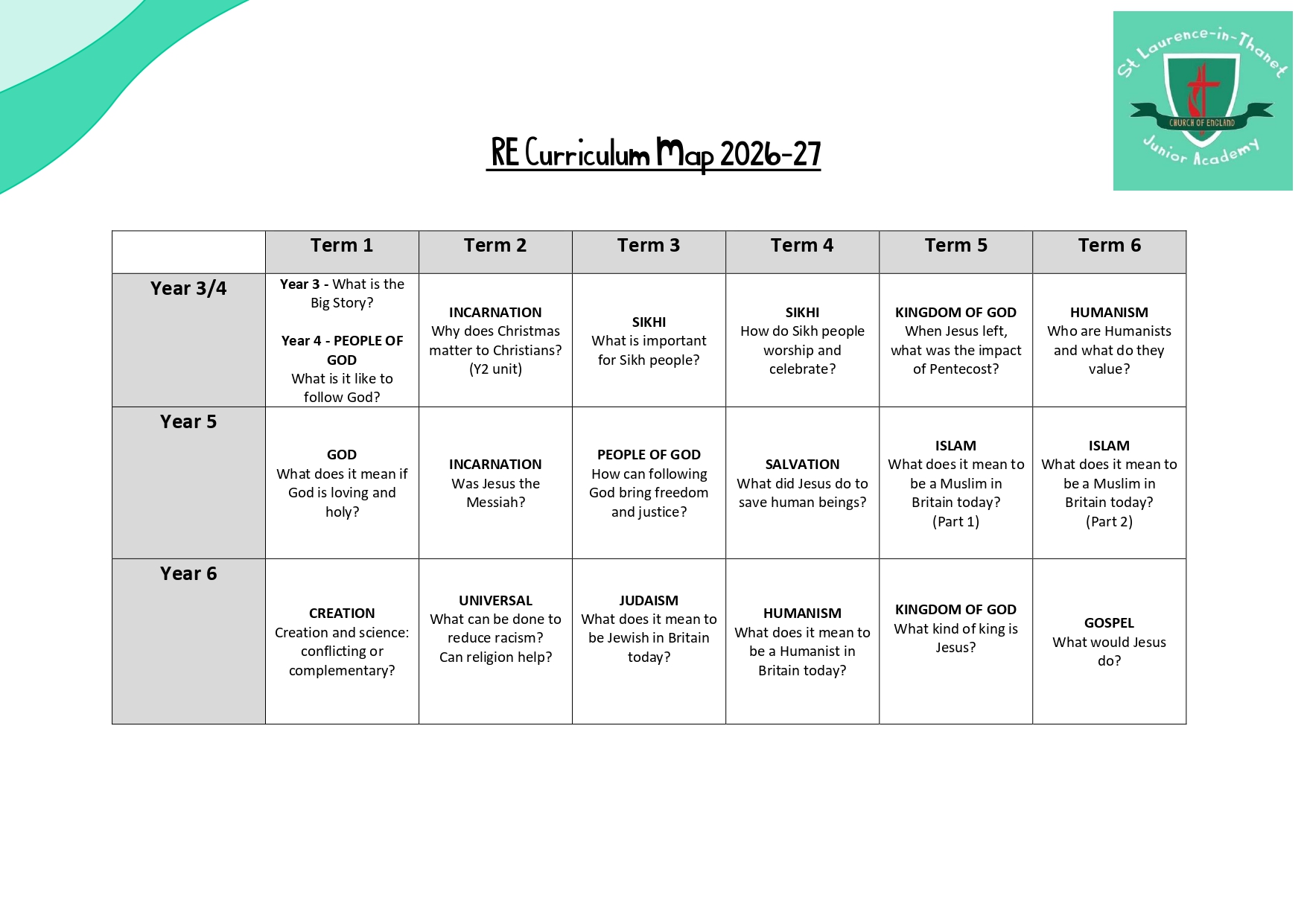
We follow the Kent Agreed Syllabus for Religious Education and use Understanding Christianity to support the teaching of Christianity.
Approximately two thirds of the curriculum focuses on Christianity. The remaining curriculum time is used to explore other religions and worldviews. This ensures that children develop a strong understanding of Christian belief while also preparing them to live respectfully in a diverse and multicultural society.
Units are organised around carefully chosen enquiry questions. These encourage children to:
• think deeply
• ask and answer questions
• examine religious texts and sources
• make connections between beliefs and practices
• compare different perspectives
• explain and justify their ideas
• reflect on what they have learnt
Children revisit the central question throughout each unit so that they can show how their thinking and understanding have developed.
Religious Education involves three closely connected ways of knowing.
• Making sense of beliefs
• Understanding the impact
• Making connections
What children learn
Throughout Key Stage 2, children develop increasingly secure knowledge of Christianity, other religions and non-religious worldviews.
Christianity
Children explore important Christian concepts, including:
• God
• Creation
• the Fall
• People of God
• Incarnation
• Gospel
• Salvation
• Kingdom of God
They examine biblical texts, consider different Christian interpretations and explore how Christian beliefs influence worship and daily life.
Other religions and worldviews
Children learn about the beliefs, practices, festivals, sacred texts and traditions of other religious communities.
They consider how people express their identity and faith and how beliefs may vary both between and within religions.
Religious and philosophical questions
Children explore questions about meaning, purpose, morality, justice, suffering, belonging and the nature of God.
They learn that some questions do not have one simple answer and develop the confidence to consider different responses.
Big questions
Big questions are central to our Religious Education curriculum. They encourage children to move beyond recalling facts and to think carefully about religious, spiritual and philosophical ideas. Children are expected to draw upon evidence, explain their reasoning and respond respectfully to the views of others.
Through these enquiries, pupils learn that beliefs can be understood and interpreted in different ways.
By the end of Year 6
By the end of Key Stage 2, children will be able to:
• demonstrate secure knowledge of Christianity and other religions and worldviews
• engage thoughtfully with religious texts and theological ideas
• use religious and theological vocabulary accurately
• explain how beliefs influence the lives of individuals and communities
• compare different beliefs, practices and interpretations
• ask perceptive religious and philosophical questions
• express their own ideas clearly and respectfully
• support their responses with evidence and examples
• listen carefully to perspectives that differ from their own
• discuss religious, spiritual and philosophical ideas in preparation for Key Stage 3 and life in a diverse society
Enrichment and wider opportunities
We enrich Religious Education through experiences that allow children to encounter lived religion and learn directly from different communities.
These opportunities may include:
• visits to churches and other places of worship
• visitors representing different religions and worldviews
• whole-school faith and festival days
• workshops and themed activities
• links with St Laurence Church
• work with the Diocese of Canterbury
• collaboration with other Church schools
• opportunities for reflection, discussion and creative responses
Whole-school faith days allow children to explore a religion or festival in greater depth and share their learning with others. Pupils are also encouraged to share their own experiences of faith and belief within a safe and respectful environment.
Supporting all learners
Our Religious Education curriculum is adapted so that every child can participate, make progress and experience success.
Teachers may use images, artefacts, stories, drama, vocabulary support, discussion, visual resources and carefully structured questions. Children can demonstrate their understanding in different ways, including through speech, writing, art and practical activities.
Sensitive consideration is given to children’s individual experiences, beliefs and communication needs. No child is expected to disclose or defend their personal beliefs.
Personal and spiritual development
Religious Education makes a significant contribution to children’s spiritual, moral, social and cultural development.
It gives pupils opportunities to:
• reflect on questions of meaning and purpose
• explore ideas about God and belief
• consider justice, forgiveness, hope and responsibility
• develop respect for different people and communities
• recognise the dignity and value of every person
• express their own ideas while listening carefully to others
• experience wonder, curiosity and thoughtful reflection
Through RE, children develop the confidence to explore their own responses while recognising that others may hold different beliefs and perspectives.
Working with others
We work closely with the Diocese of Canterbury and with other Church schools across Thanet. Sharing good practice, resources and professional development helps us to keep our Religious Education curriculum relevant, thoughtful and responsive to the changing world.